
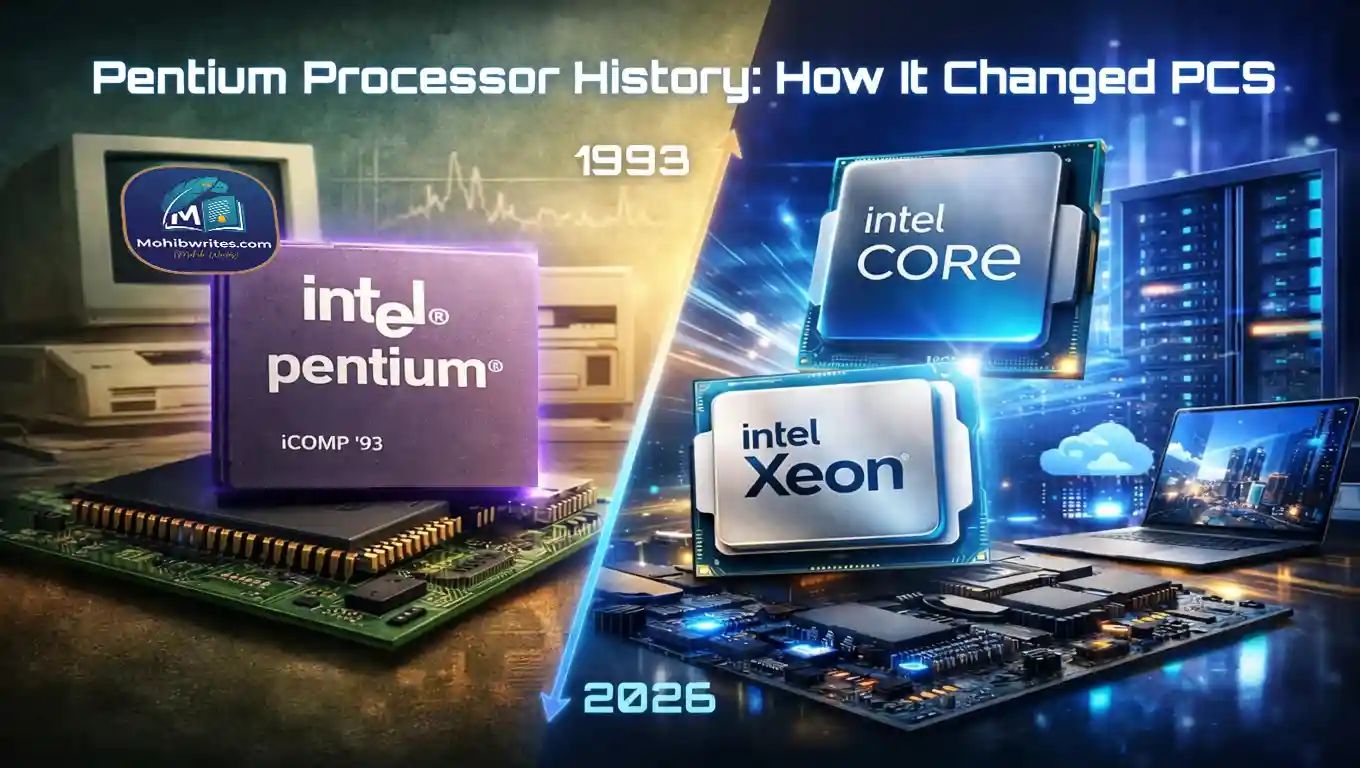
Pentium processor history shows how Intel’s 1993 launch turned a faster chip into a full PC-era reset. Intel’s own timeline calls Pentium its fifth-generation x86 chip and the first Intel processor named with a word instead of a number; Britannica adds that it shipped with around 3.1 million transistors, a 64-bit data bus, built-in floating-point and memory-management units, and two 8KB caches.
The Technical Leap That Mattered
Pentium was not just “a bit faster.” It pushed x86 forward with superscalar execution, which let the chip handle more than one instruction path at once. IEEE Micro notes that compared with the i486, Pentium added hardware to speed instruction execution and significantly improved superscalar execution, branch prediction, and cache organization. Intel’s history page also says the chip was five times more powerful than the i486 and 300 times faster than the 8088 that powered the first IBM PC.
What changed inside the chip
- Faster instruction flow through superscalar design.
- A stronger floating-point unit for graphics, science, and 3D work.
- Better cache handling so frequently used data came back faster.
- A wider data path that helped the processor move information more efficiently.
Why the Pentium name hit so hard
Intel did not just launch a chip; it launched a brand. Intel’s timeline says the word “Pentium” came from a companywide naming contest, and Britannica notes that Pentium marked Intel’s move away from number-based naming conventions. That shift mattered. “Pentium” was easier to remember, easier to market, and much harder to reduce to a boring spec-sheet footnote.
There was also a strategic edge here. Intel’s own history says the company chose the word name after legal pressure made number-only names harder to protect as trademarks. In other words, Pentium was both an engineering milestone and a branding move with teeth.
Why the market noticed so quickly
The timing was perfect. Intel Technology Journal explains that during the Pentium ramp in 1993, the home market was becoming a major PC buyer, driven by multimedia applications. Britannica adds that faster Pentium machines helped consumers use PCs for multimedia graphical applications such as games that needed more processing power. That is the real inflection point: the PC stopped feeling like a work-only machine and started becoming a richer consumer platform.
What I see in platform shifts like this is a simple pattern: once the CPU gets strong enough, software gets bolder. That’s exactly what happened here. Pentium did not invent multimedia computing, but it gave developers more room to build for it. And once that happened, expectations changed fast.
Why Pentium still matters in March 2026
As of March 2026, Intel’s current PC story looks very different, but the DNA is familiar. Intel’s Core Ultra Series 3 launched as the first AI PC platform built on Intel 18A, and Intel’s Xeon 6 line is positioned for web and microservices, analytics, and other demanding server workloads. The hardware has changed. The core idea has not: do more inside the chip, and make the whole system feel faster and smarter.
Pentium’s legacy is easy to spot if you know where to look. Superscalar thinking, cache-first design, and stronger floating-point performance are still part of modern CPU conversations. Intel’s current processor lineup still centers on that same promise: better performance, better efficiency, and more capability per chip.
Then vs. now
In 1993, Intel shipped Pentium at 60 and 66 MHz. In 2026, Intel’s current focus is not a single clock number; it is AI PCs, multithreaded performance, built-in accelerators, and data-center efficiency. That is why Pentium processor history still makes sense as a reference point: it marks the moment the PC became a more ambitious machine.
Pentium was not just a product launch. It changed what buyers expected from a PC, what developers expected from a CPU, and what Intel expected from its own brand. Pentium processor history matters because it explains the shift from “good enough” computing to the faster, richer, more demanding PC era we still live in. What’s the very first experiment you’re going to run this week?
People Also Ask (FAQs)
It was the jump from a normal upgrade to a real platform shift. Pentium brought superscalar execution, stronger floating-point performance, and better cache design, which made PCs faster and more capable for everyday users.
Yes. Britannica says Pentium was the first Intel chip for PCs to use parallel, or superscalar, processing. That is one of the biggest reasons it stood out from the i486.
Intel moved away from number-only names because they were harder to trademark and less distinctive. Intel’s history page says the name came from a companywide contest and marked the start of a word-based naming era.
It gave developers more CPU headroom, especially for graphics-heavy and multimedia work. Intel’s technology journal and Britannica both show that Pentium arrived just as home multimedia and games were becoming major PC use cases.
Intel moved on through later x86 generations, including Pentium Pro and beyond, and today its core PC and server lines are Core Ultra and Xeon. As of March 2026, Intel’s newest consumer platform is Core Ultra Series 3, while Xeon 6 serves modern data-center workloads.
Because it shows the moment CPUs stopped being just faster parts and started becoming the main engine for richer software experiences. That idea still drives Intel’s current AI PC and server strategy.