
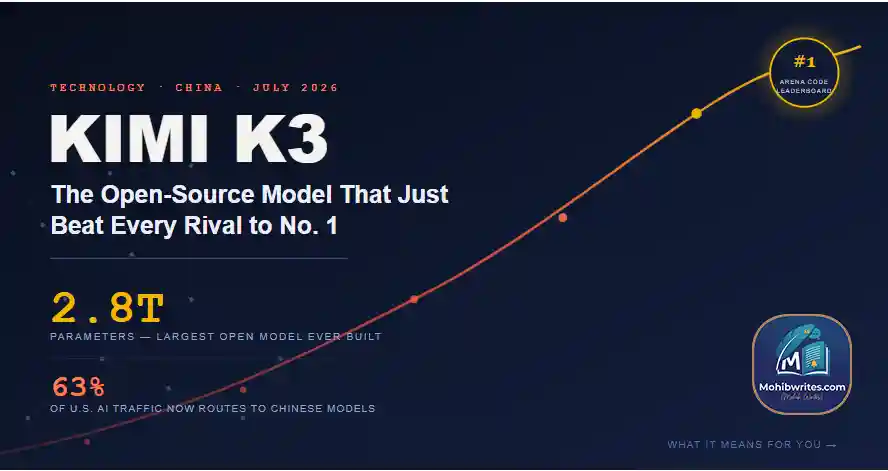
Kimi K3, Moonshot AI’s new open-source model, launched on July 16, 2026, and within hours it had climbed to the No. 1 spot on the Arena coding leaderboard — the first Chinese model ever to do so. That’s not a marketing footnote. That’s a signal the open-source AI race just changed shape.
I’ve been tracking open-weight model releases since the first LLaMA leak, and most “biggest ever” claims fade within a news cycle. This one’s sticking around. Here’s why it matters, what it actually does, and what it signals about where AI development is headed.
What Makes Kimi K3 Different
At 2.8 trillion parameters, Kimi K3 is now the largest open-source AI model ever released, according to Moonshot AI. Independent coverage confirms it’s a sparse mixture-of-experts design — only a slice of those parameters activate on any given request, which keeps inference costs down even at that scale. It also ships with a 1-million-token context window, native image understanding, and two in-house architectural tweaks (Kimi Delta Attention and Attention Residuals) built for long, agentic coding sessions.
What actually got developers’ attention wasn’t the parameter count — it was the benchmark result. K3 landed at No. 1 in the Arena Frontend Code evaluation, jumping 17 spots from its predecessor, Kimi K2.6. In plain terms: this isn’t a lab demo. Developers running real coding tasks ranked it best-in-class, full stop.
As of July 2026, full model weights were scheduled for public release on July 27, meaning anyone — a solo developer, a research lab, an enterprise team — will be able to download, inspect, and fine-tune the thing themselves. No gatekeeping. No waitlist.
Why Open Source Keeps Winning Ground
Here’s what I’ve seen working with teams evaluating AI vendors this year: the conversation has quietly shifted from “which model scores highest” to “which model can we actually afford to run at scale.” That shift is exactly what’s fueling China’s open-source push.
Liu Tieyan, president of the Zhongguancun Academy, put it simply: openness and circulation are what give technology its staying power, and Chinese open-source models are moving from isolated wins to a shared ecosystem effect. That’s not just PR language — the usage data backs it up.
Some key data points worth sitting with:
- Open-source AI models have racked up more than 10 billion downloads worldwide.
- At one international venture capital firm, roughly 80% of portfolio companies adopting open-source AI chose Chinese models.
- Chinese models overtook U.S. competitors in token traffic on OpenRouter for the first time this year, hitting 63% of routed traffic among U.S. firms during the first week of July 2026 — with DeepSeek becoming a go-to choice for American enterprises.
That last stat is the one that should make any CTO pause. When American companies are routing the majority of their AI workloads through Chinese-built models, cost and capability have crossed a line that used to feel theoretical.
The Bigger Play: AI Cooperation, Not Just Competition
Kimi K3 didn’t launch in a vacuum. The same week, China’s National Development and Reform Commission released the Action Plan for Artificial Intelligence Cooperation and Development, alongside a case collection called China Intelligence, Global Benefits (2026) — now in its third year. This edition covers more countries, more “AI+” use cases, and leans harder into a “people-centered, AI for good” framing.
Is this altruism or strategy? Probably both, and that’s fine — most industry shifts are. What matters practically is that lower barriers to entry mean smaller countries, startups, and research teams that couldn’t afford frontier compute now have a credible on-ramp.
What This Means If You're Evaluating AI Tools Right Now
If you’re choosing a model for a coding pipeline, a customer-facing agent, or an internal research tool, here’s the practical takeaway: open-weight models are no longer the “budget option” you settle for. They’re increasingly the performance option too.
A quick gut-check before you commit to any provider:
- Check the actual benchmark for your use case — not the overall leaderboard, the one that matches your workload (coding, reasoning, multilingual, etc.).
- Price out total inference cost, not just the sticker price per token — open-weight models you self-host change your cost math entirely.
- Confirm licensing terms before deploying commercially; “open-source” doesn’t always mean unrestricted use.
- Watch the ecosystem, not just the model — tooling, fine-tuning support, and community activity often matter more long-term than a single benchmark win.
The Bottom Line
Kimi K3 is a genuine technical achievement, but the more interesting story is what it represents: a maturing open-source AI ecosystem that’s starting to out-compete closed systems on both performance and accessibility. Whether you’re a developer picking your next coding assistant or a policymaker thinking about digital equity, this is a trend worth watching closely, not a headline to skim past.
So here’s the real question: if a 2.8-trillion-parameter model is free to download next week, what’s the first thing you’d test it on?