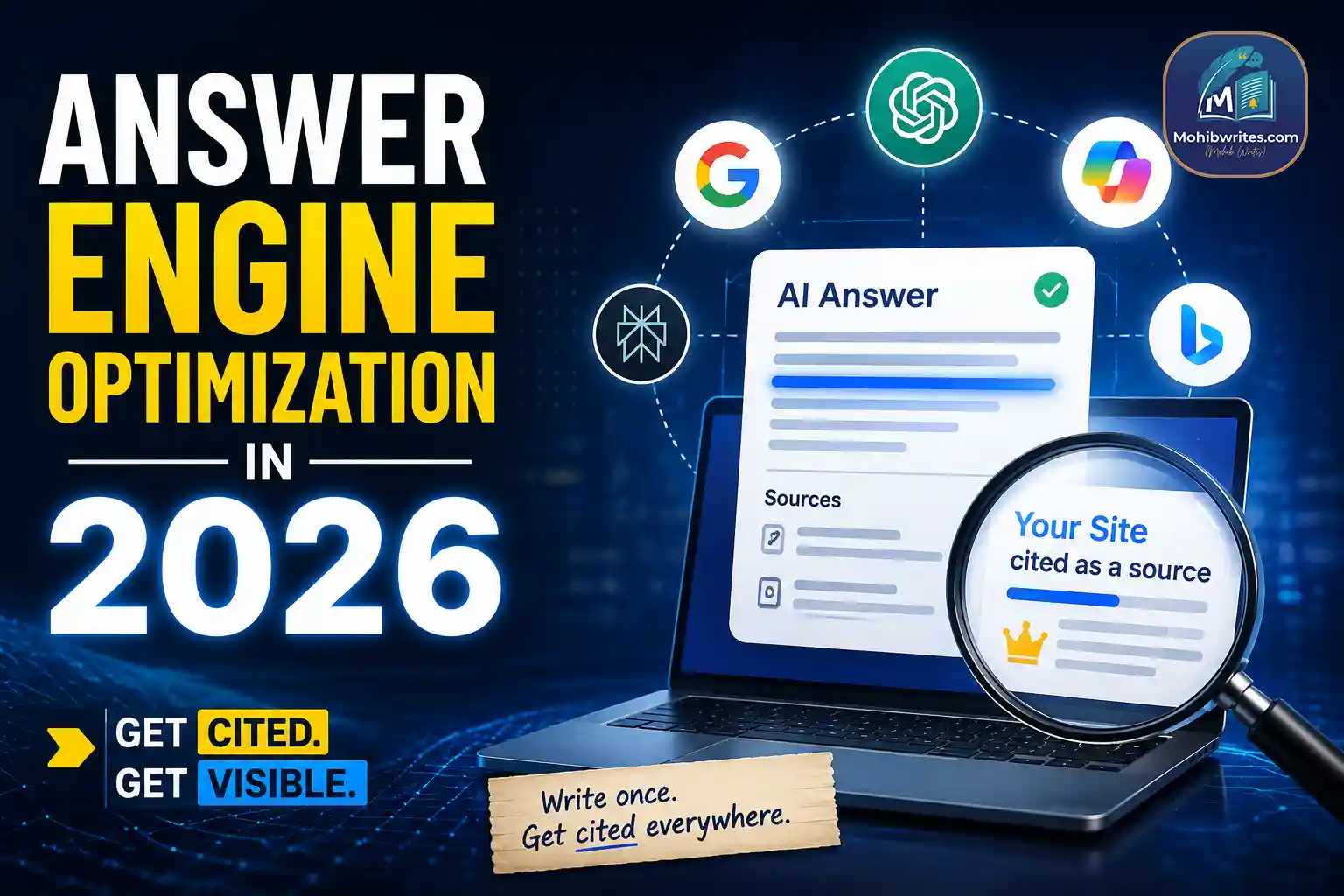
Answer engine optimization is the practice of making content easier for AI-powered search systems to find, understand, trust, and cite in direct answers. As of August 2026, AEO is not a replacement for SEO. It’s an expansion of it, shaped by Google AI Overviews, AI Mode, Microsoft Copilot, Bing generative answers, ChatGPT Search, Perplexity, and other retrieval-based answer systems.
The winning approach is simple but demanding: publish content that answers real questions clearly, proves its claims, remains technically accessible, and offers value beyond a rewritten summary of what already exists.
Integrating GEO with SEO: Navigating the Future of Search Optimization
How answer engines choose content
Most modern answer engines don’t “rank” pages exactly like traditional search results. They retrieve relevant documents, extract useful passages, synthesize answers, and often cite supporting sources.
Google’s official guidance says its generative AI search features are rooted in core Search ranking and quality systems and use methods such as retrieval-augmented generation and query fan-out. That means traditional SEO fundamentals still matter: crawlability, indexing, helpful content, strong topical relevance, and clear page structure.
OpenAI’s crawler documentation also separates search visibility from model training. For example, OAI-SearchBot is used to surface websites in ChatGPT search features, while GPTBot relates to training. Perplexity similarly identifies PerplexityBot as the crawler used to surface and link websites in search results.
The practical implication: if AI systems can’t access, parse, or trust your content, they’re less likely to reference it.
What AEO requires now
Strong answer engine optimization focuses on four things:
Microsoft’s Bing Webmaster Blog says its AI Performance dashboard shows citations, cited pages, grounding queries, and page-level citation activity across supported AI experiences. That signals where search is heading: visibility is no longer only about blue-link rankings; it’s also about whether a page becomes a trusted source inside an answer.
AEO, GEO, and SEO: what’s the difference?
- SEO improves visibility in search engines.
- AEO improves the chance that content becomes a direct answer.
- GEO, or generative engine optimization, focuses on visibility in generative responses.
The terms overlap. Google explicitly treats AEO and GEO as labels for optimizing for AI search experiences, not as separate systems requiring hacks. The 2024 ACM KDD paper “GEO: Generative Engine Optimization” found that optimization strategies could improve visibility in generative engine responses, but it also showed results vary by domain. That matters: there is no universal trick.
What not to do
Avoid creating thin pages for every long-tail variation. Don’t chase fake brand mentions. Don’t assume llms.txt, special AI markup, or excessive “chunking” will improve Google visibility; Google says these are not required for its generative search features.
Better work wins: original explanations, first-party insight, precise definitions, current facts, clean technical SEO, and content that deserves to be cited.
The Practical Takeaway
Treat AEO as editorial quality plus technical accessibility. Answer the question directly. Make the source trustworthy. Keep the page crawlable. Add evidence. Update stale claims. If a human editor would consider the page the clearest and most reliable answer, an answer engine has a better reason to use it too.