
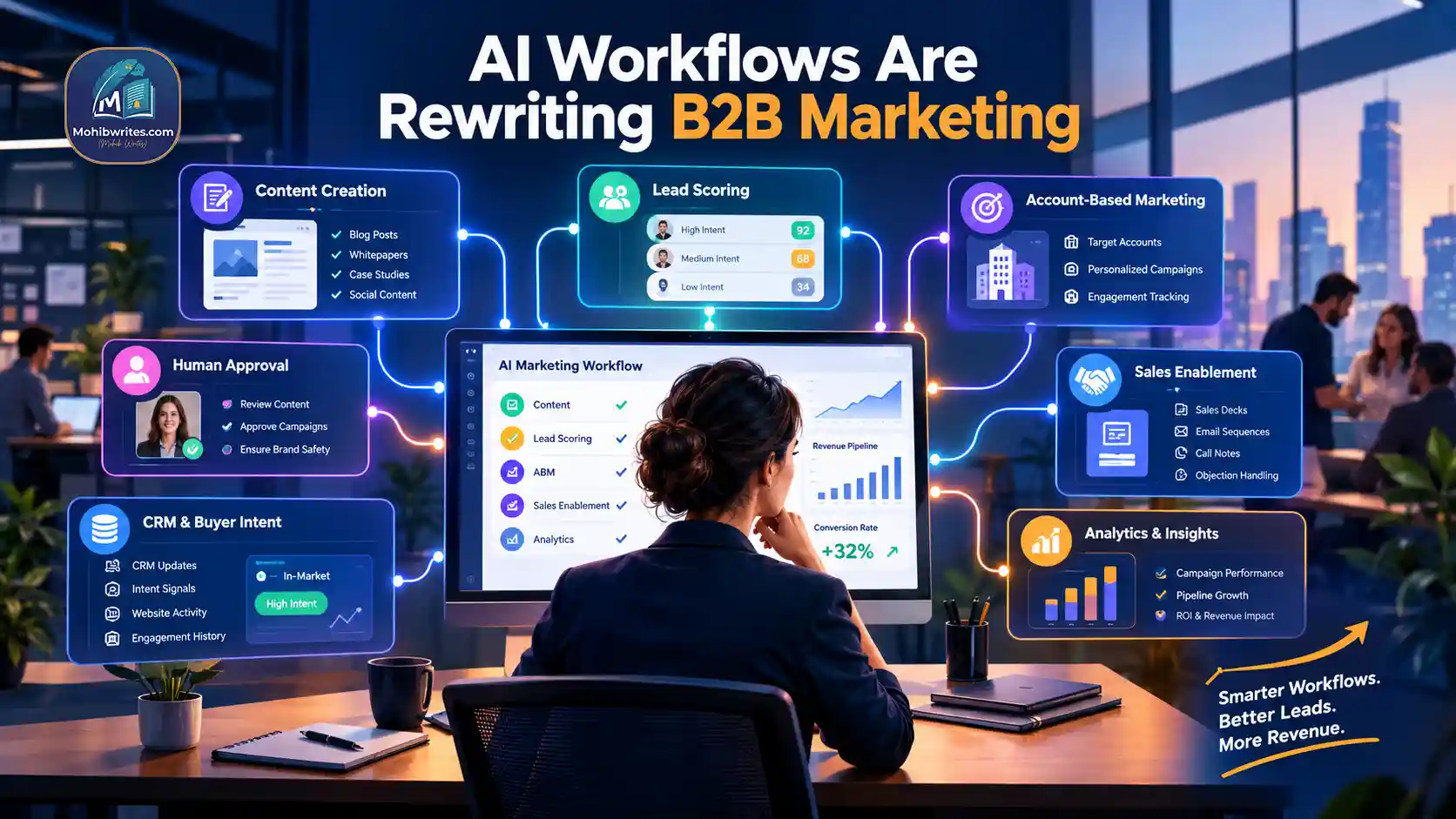
B2B AI marketing workflows help teams turn scattered tasks into faster, more consistent systems for content, lead scoring, personalization, and sales alignment. The strongest teams do not use AI as a shortcut for more output. They use it to reduce waste, sharpen decisions, and protect quality.
The demand is clear. The Content Marketing Institute’s 2025 B2B research found that 81% of B2B marketers use generative AI tools. Yet only 19% have integrated AI into daily workflows. That gap matters. Tools create activity. Workflows create repeatable performance.
What Are B2B AI Marketing Workflows?
B2B AI marketing workflows are structured processes that use AI to support specific marketing outcomes. These outcomes may include research, segmentation, content creation, lead scoring, campaign testing, reporting, or sales enablement.
A useful workflow has five parts:
- A clear business goal
- Clean source data
- A defined AI task
- Human review
- A measurable next step
For example, AI can summarize account research, score intent signals, draft a sales email, and send the summary to a CRM. But a marketer or sales lead should still approve messaging, claims, and timing.
Where AI Delivers the Most Value
AI works best when it supports high-volume, pattern-heavy tasks. It helps teams move faster without asking people to start from a blank page.
Strong B2B use cases include:
- Content briefs from search intent and customer pain points
- Webinar repurposing into emails, social posts, and sales notes
- Lead and account scoring based on fit and behavior
- Account-based marketing personalization
- Competitive research summaries
- Campaign reporting and anomaly detection
- Sales enablement briefs for target accounts
This aligns with broader adoption trends. HubSpot’s State of Marketing report says 80% of marketers use AI for content creation, and 75% use it for media production. That makes content the entry point. It should not be the endpoint.
The Workflow That B2B Teams Should Build First
Start with a content-to-sales workflow. It connects marketing effort to pipeline support.
Use this simple model:
- Identify one buyer problem.
- Pull evidence from customer calls, CRM notes, search data, and sales objections.
- Ask AI to cluster themes and draft a brief.
- Let a subject-matter expert review the logic.
- Create one core asset.
- Repurpose it into sales emails, LinkedIn posts, nurture copy, and FAQ answers.
- Track engagement by account and buying stage.
This workflow solves a common B2B problem. Teams often create content that sales never uses. AI can help package insights for different channels. Humans must still provide judgment, accuracy, and positioning.
Do AI Workflows Improve Personalization?
Yes, but only when teams connect AI to reliable data. AI can personalize by industry, role, account stage, pain point, or product interest. It can also summarize what a buying committee appears to care about.
Salesforce reports that 83% of marketers recognize the shift toward personalized, two-way messaging, but only one in four feel satisfied with how they use data for those moments. That shows the real blocker. It is not prompt writing. It is data quality.
Bad data creates confident nonsense. Good data creates useful context.
The Governance Layer Most Teams Miss
Every B2B AI workflow needs rules. CMI found that 45% of B2B marketers still lack AI usage guidelines, though that improved from 61% the previous year. Guidelines should cover acceptable use, data handling, review standards, brand voice, citations, and legal approval.
Google’s guidance on AI content also gives a useful principle:
high-quality content matters more than how the content gets produced. So do not publish AI-assisted content because it is fast. Publish it because it is accurate, useful, and reviewed.
What Separates Strong Teams From Average Teams?
Strong teams redesign workflows before they buy more tools. They ask better questions:
- Which task slows revenue?
- Which decision needs better data?
- Which handoff breaks between marketing and sales?
- Which content asset gets reused most?
- Which AI output needs human approval?
McKinsey’s AI research shows that many companies still struggle to turn AI use into financial impact, even while workers report productivity gains in daily work. Its State of AI research reinforces the same lesson: value comes from operating-model change, not casual tool use.
Final Takeaway
B2B AI marketing workflows work when they improve decisions, not just production speed. Start with one workflow. Tie it to one business outcome. Add clean data, human review, and clear measurement.
AI does not fix a broken funnel. It exposes it faster. The winning teams will use that visibility to build sharper, simpler, and more trusted marketing systems.