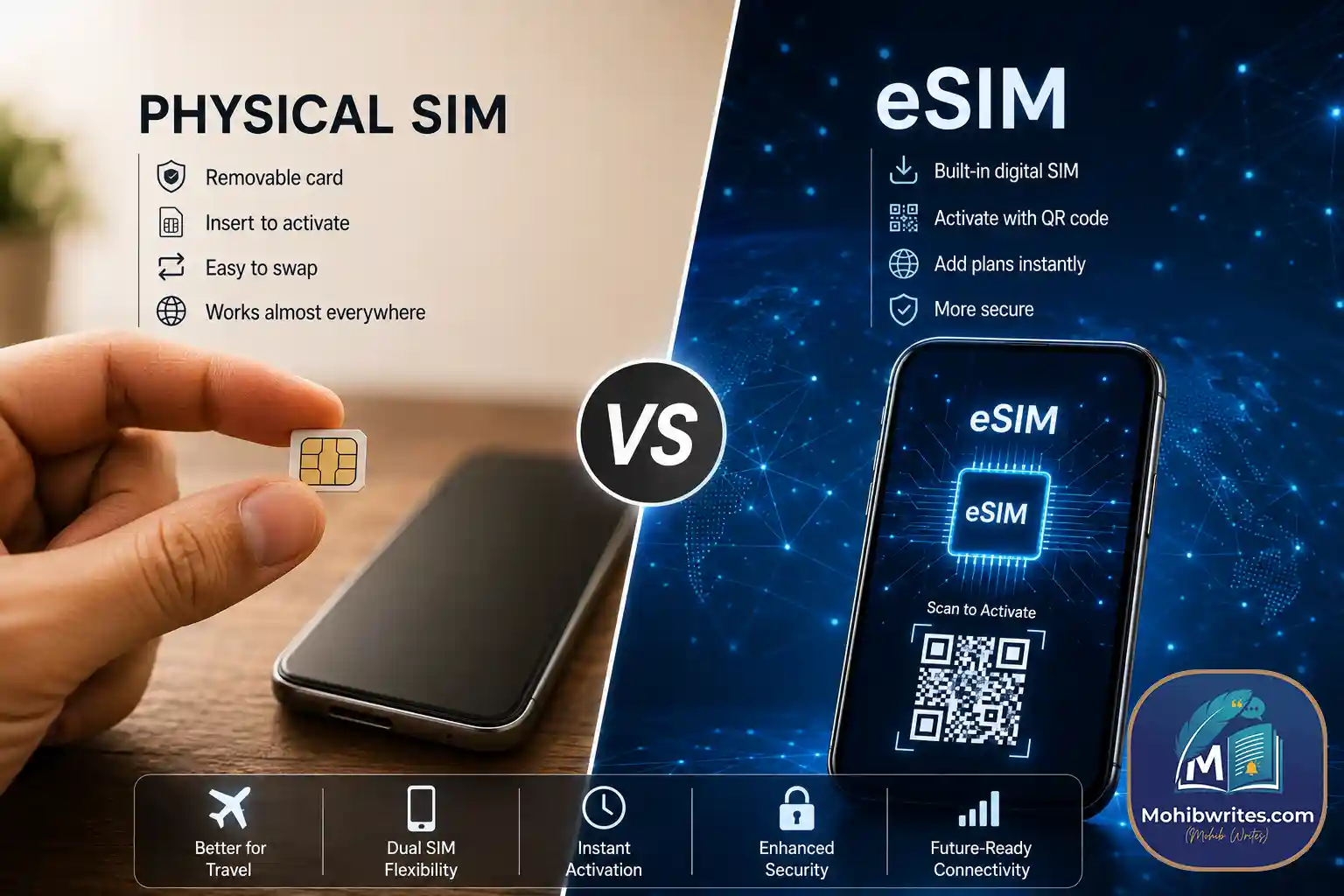
eSIM and physical SIM cards both connect your phone to a mobile network, but the main difference is form: a physical SIM is a removable card, while an eSIM is built into the device and activated digitally.
For most users, eSIM is more convenient. For some, especially people with older phones, limited carrier support, or a habit of frequently swapping devices, a physical SIM still has practical advantages.
What Is an eSIM?
An eSIM, or embedded SIM, is a programmable SIM built into a phone, tablet, smartwatch, or connected device. Instead of inserting a plastic SIM card, you activate a mobile plan by scanning a QR code, using a carrier app, or transferring a plan through supported device settings.
Organizations such as the GSMA define eSIM as a standard that allows remote SIM provisioning, meaning a carrier profile can be downloaded and managed digitally. Apple, Google, Samsung, and major mobile carriers now support eSIM across many recent devices, though availability still depends on country, carrier, and model.
What Is a Physical SIM?
A physical SIM is the removable chip card that stores the subscriber identity needed to connect a device to a mobile network. It comes in different sizes, with nano-SIM being the common format in modern smartphones.
Physical SIMs are simple, widely supported, and easy to move between compatible unlocked phones. That familiarity is their biggest strength.
eSIM vs Physical SIM: Quick Comparison
Advantages of eSIM
The biggest advantage of eSIM is convenience. You can activate service without waiting for a SIM card in the mail or visiting a store. Travelers can often buy a local or regional data plan before landing and activate it on arrival.
eSIM also helps with dual SIM use. Many phones allow one physical SIM plus one eSIM, or multiple stored eSIM profiles with one or two active at a time, depending on the device. That makes it useful for separating work and personal numbers.
Security is another advantage. Because an eSIM cannot be removed from a stolen phone, it may make it harder for thieves to quickly disable mobile connectivity. However, eSIM does not eliminate account takeover risks such as SIM-swap fraud; carrier account security still matters.
Disadvantages of eSIM
The main drawback is compatibility. Not every phone supports eSIM, and not every carrier offers smooth eSIM activation. Some prepaid plans, rural carriers, or international networks may still rely heavily on physical SIM cards.
Switching phones can also be less straightforward. Moving a physical SIM takes seconds. Moving an eSIM may require carrier approval, a new QR code, app-based transfer, or supported phone-to-phone migration.
If your device breaks, recovering service from an eSIM-only phone may take more effort than simply removing a card and placing it in another phone.
Advantages of Physical SIM
Physical SIM cards remain useful because they are universal, visible, and easy to control. If your phone is unlocked and compatible, you can usually move the SIM to another phone immediately.
They are also helpful in markets where eSIM support is inconsistent. Budget phones, older smartphones, basic phones, and some travel destinations still make physical SIMs the safer fallback.
Which One Should You Choose?
Choose eSIM if you have a newer phone, your carrier supports it well, you travel often, or you want faster digital activation. Choose a physical SIM if you frequently switch devices, use an older phone, need maximum carrier compatibility, or want the simplest recovery option if your phone fails.
The best setup for many people is dual support: keep a physical SIM slot available while using eSIM for travel, work, or a second number.
Conclusion
eSIM is the more modern and flexible option, but physical SIM is still valuable because it works almost everywhere and remains easy to swap. Before choosing, check three things: your phone model, your carrier’s eSIM support, and how often you switch devices. The right SIM is the one that makes staying connected easier—not the one that sounds newer.