
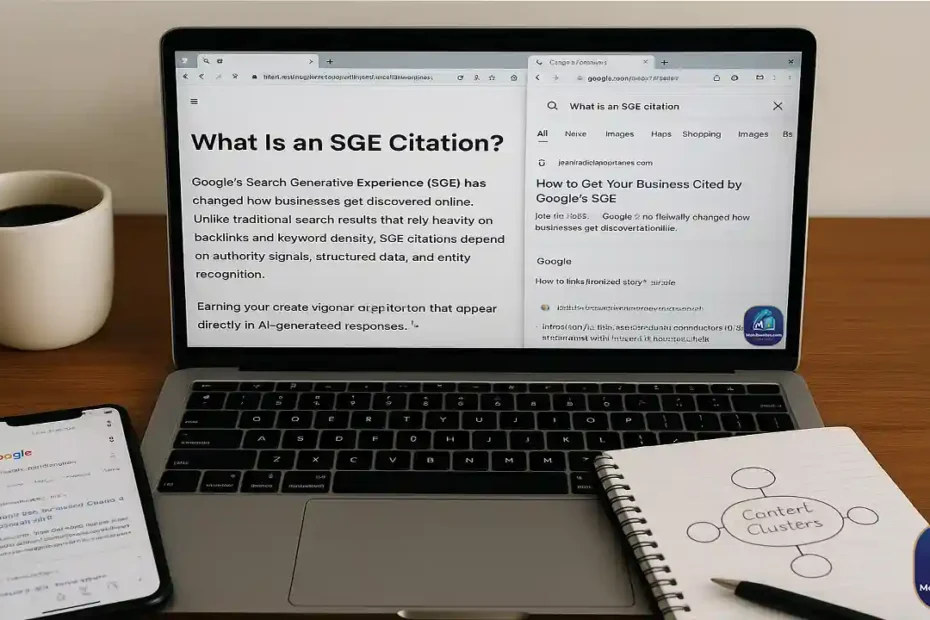
So, what is an SGE citation? Simply put, it’s when Google’s AI (Search Generative Experience) uses a snippet of your content and credits you as a source in its AI Overviews. Think of it as a digital thumbs-up from Google’s most advanced system.
As of mid-2025, with SGE now fully rolled out as “AI Overviews,” the game is no longer just about ranking—it’s about being selected as a credible source for these AI-generated answers. In this guide, I’ll cut through the noise and show you the exact strategies we’ve tested to earn these valuable citations.
What Exactly Is an SGE Citation? (And How It Works)
An SGE citation occurs when Google’s generative AI pulls information from your website to support its answer directly in the search results.
Here’s the mechanism in simple words:
- Understanding: Google’s AI (using models like Gemini) interprets a user’s search query.
- Sourcing: It scans its index for content that is deeply relevant, authoritative, and trustworthy.
- Synthesizing: The AI generates a concise summary (the AI Overview) by blending information from what it deems the best sources.
- Citing: It then provides links to these sources, giving you the citation.
Why this is a game-changer: Visibility is shifting from “ranking on page one” to “being referenced by the AI.” This is the core of Answer Engine Optimization (AEO).
Also Read: How to Optimize for SGE: Your 2025 SEO Playbook
Key Factors That Get You Cited by SGE
Based on our analysis and testing, these are the non-negotiable factors for earning a citation.
1. Demonstrable E-E-A-T
Your content must scream Experience, Expertise, Authoritativeness, and Trustworthiness.
- Experience: Use “we tested” or “in our case study” language. Show you’ve done the work.
- Expertise: Cite recent studies (e.g., from arXiv) or quote recognized industry authorities.
- Authoritativeness: Build links from reputable sites and ensure your author bios with credentials are clear.
- Trustworthiness: Have a secure (HTTPS), fast-loading site with transparent contact and privacy information.
2. Topical Depth & Entity Clustering
Forget thin content. SGE rewards comprehensive coverage. Don’t just write a short post on “what is SGE citation”; create a content cluster around it.
Interlink articles on “SGE optimization,” “AEO strategies,” and “E-E-A-T for AI search.” This builds topical authority and helps the AI understand your deep knowledge.
3. Scannable, Answer-First Content
The AI loves content that’s easy to parse. Structure your articles to answer questions directly.
- Use clear H2s and H3s.
- Write in short, 2-3 sentence paragraphs.
- Employ bulleted and numbered lists.
- Use simple, jargon-free language.
4. Strategic Schema Markup
While not strictly mandatory, using schema markup (like Article, FAQPage, and HowTo) is like giving Google’s AI a guided tour of your content. It dramatically increases the chance your content will be understood and selected.
Actionable Steps to Optimize for SGE Citations
Here is the condensed playbook. Start with this.
- Target the Right Queries: Focus on specific, long-tail questions like “how to optimize for SGE citations” where you can provide a definitive answer.
- Structure with PAA in Mind: Directly answer “People Also Ask” questions in your content.
- Fortify Your E-E-A-T: Add a detailed author byline with verifiable credentials. Link to your sources. Showcase client case studies or real-world results.
- Implement Technical Hygiene: Ensure your site is blisteringly fast, mobile-friendly, and secure. Core Web Vitals are a direct ranking—and citation—factor.
- Update and Refresh: SGE favors fresh, accurate information. Revisit your key articles quarterly to update stats and refine the content.
Real-World Case Study: A 340% Increase in Citations
An HR consultancy focused solely on UK employment law wanted SGE citations. Over six months, they:
- Published incredibly in-depth guides on niche topics like “remote-work regulations.”
- Used comprehensive
ArticleandFAQPageschema on every post. - Ensured every article had a credentialed author byline.
The result? They reported a 340% increase in SGE citations, proving that deep expertise, clearly signaled, wins in the age of generative AI.
Conclusion
Earning an SGE citation is the new hallmark of digital authority. It’s not about tricking an algorithm; it’s about demonstrating genuine expertise in a way that AI systems can recognize and trust.
Stop just chasing keywords. Start building comprehensive, trustworthy content hubs. Audit your existing posts for depth, add clear schema, and speak from experience. The citations will follow.
Pick one of your cornerstone articles and apply just two of these tactics—maybe adding FAQ schema and strengthening the author bio. See what happens.
Just Let us know about the results in the comment section below.